

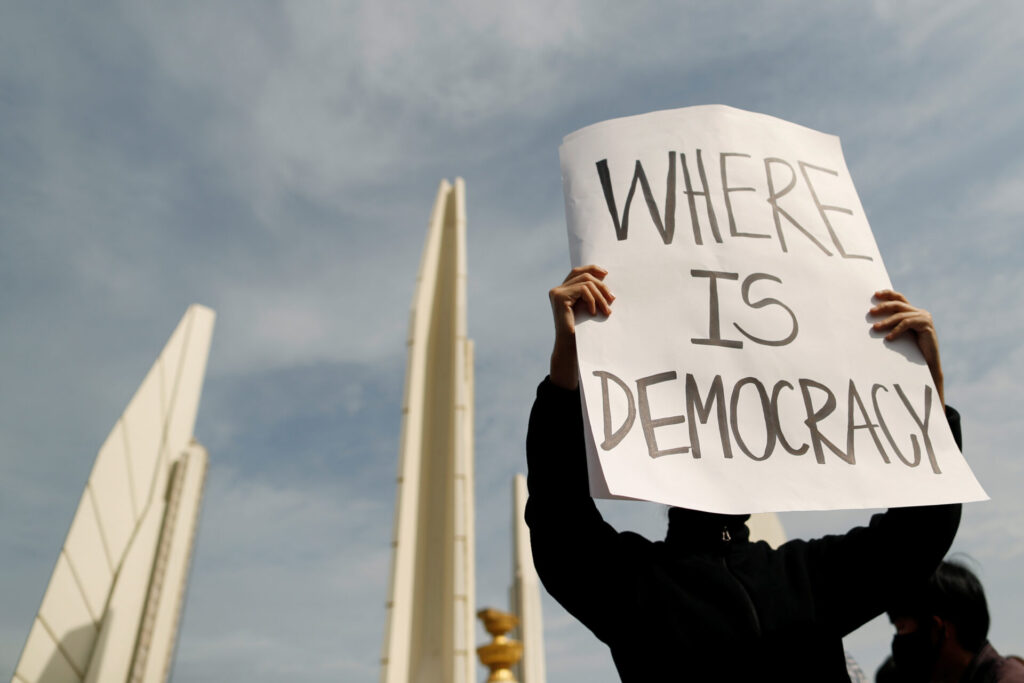
In light of the two-decade-long global democratic recession, which continues to deepen, scholars of democracy along with policymakers and activists have become increasingly focused on the need to build democratic resilience. Following the work of political scientist Wolfgang Merkel, we now commonly understand democratic resilience as having two critical components: first, the ability of a political system to withstand authoritarian threats; and second, the capacity of that system to adapt and become both more durable and more democratic.1 The idea underpinning this framing is that true resilience is about more than simply preventing authoritarian collapse. It also involves the capacity in the aftermath of an authoritarian turn not just to bounce back but to fortify the political system on the basis of core democratic principles—essentially future-proofing democracy.2
This broader, more transformative framing of democratic resilience makes sense. There are numerous reasons why a simple return to the state of play prior to an authoritarian episode will not safeguard global democracy, not least because many countries in Africa, Asia, and Latin America, as well as some in Europe, were at best flawed democracies to begin with. Yet the heavy and optimistic emphasis on so-called democratic U-turns, bolstered by seemingly positive recent examples such as Poland and Senegal, obscures an uncomfortable truth: In reality, since 1994, many of the political systems that supposedly returned to democracy after an authoritarian episode did not manage to reverse the damage [End Page 33] done to their democracies, and in fact subsequently experienced another period of democratic decline within less than five years.
The case of Brazil illustrates the fragility of democratic turnarounds. In the 2022 presidential election, the right-wing populist Jair Bolsonaro (2019–23) lost to former president Luiz Inácio Lula da Silva, despite employing a range of undemocratic strategies. Two years on, Lula’s return to power has yet to erase the legacies of Bolsonaro’s leadership, let alone build a stronger democratic system. Brazil remains a polarized country, with many citizens still believing Bolsonaro’s (false) claims of a rigged election, which inspired some supporters to attack federal government buildings in the wake of his defeat. Clear-eyed analyses of other countries regularly cited as having recently demonstrated resilience, including Bangladesh and Zambia, tell a similar story.
More broadly, our analysis of all countries that experienced a democratic turnaround—that is, to have gone from being democratic to authoritarian and back again—since 1994 reveals that nearly 90 percent failed to sustain the level of democracy they returned to for at least five years following the end of the turnaround.3 Rather than a victory for democracy, the temporary nature of these U-turns may simply reflect ongoing patterns of political volatility. We must therefore ask why countries that appear to bounce back so often fail to redemocratize.
A review of a database of thirty cases between 1990 and 2022 suggests three important and widely shared factors. First, even short bouts with autocratization can have a lasting impact on democracy. Legal changes that introduce repressive legislation may be difficult to reverse, especially when combined with personnel changes that place antidemocratic individuals in key positions, inserting autocratic veto players into the political system. These kinds of authoritarian holdovers have complicated efforts to strengthen democracy in countries as diverse as Bangladesh, Poland, and Sri Lanka.
The second key factor is the desire—not to mention the motives and incentives—of prodemocratic political leaders, parties, and coalitions to stay in power once they have won election. Prodemocracy alliances are often broad churches, with some members determined to promote democratic norms and others more interested in using the coalition to strengthen their own chances of taking power. It is therefore not surprising that the new governments they form often resist relinquishing the extensive powers inherited from the previous autocratic regime. This issue is particularly acute in contexts where political institutions are fragile and public trust in politics is low. In these kinds of political contexts—which tend to be particularly pronounced in Africa, Asia, and South America—even leaders with democratic intentions may find little motivation to foster a more durable, accountable regime. In Zambia, for example, the government of President Hakainde Hichilema (2021–present) has begun to roll back its commitment to strengthen [End Page 34] democracy in the wake of his predecessor Edgar Lungu’s more authoritarian rule (2015–21).
Finally, the conditions for strengthening democracy globally have deteriorated over the last thirty years. Social polarization around identity, a greater willingness among citizens to tolerate authoritarian interventions if civilian leaders fail to deliver on promises, and cross-border misinformation and propaganda campaigns—spread, for example, by Russia in parts of Eastern Europe and West Africa—have proliferated alongside rising anti-elite and anti-rights narratives. We have seen various combinations of these factors stymie attempts to deepen democracy in Mali, Malawi, Mexico, Moldova, and elsewhere.
Taken together, the combined effect of these factors means that countries are unlikely to improve their democracies after an authoritarian episode—or even to maintain the level of democracy they had beforehand for very long. Instead, there is a risk that after every authoritarian episode, the likelihood that a country will rebound to its previous level may diminish. We must therefore critically evaluate U-turns and claims of democratic resilience in order to develop a more realistic understanding of the danger that authoritarian episodes pose to global democracy.
Separating Aspirations from Reality
Perhaps the most thoroughly operationalized understanding of democratic resilience comes from ongoing work at the Varieties of Democracy (V-Dem) Institute, which has identified and measured three different kinds of resilience: 1) onset resilience, where autocratization is prevented altogether; 2) breakdown resilience, where autocratization occurs but regime change is avoided; and, finally, bounce-back resilience, where democracies recover after a short period of autocratization.4 Resilience as recovery manifests in two ways: Democratic U-turns occur when a country returns to roughly the same level of democracy it had before the backsliding episode on V-Dem’s Electoral Democracy Index (EDI), while J-turns are turnarounds that surpass the prior level of democracy. Between 1900 and 2022, nearly 70 percent of all turnaround episodes were U-turns.5
The frequency with which democracies have historically rebounded has led some to claim that U-turns are the “hope for democratic resilience.”6 The data generated by V-Dem is extremely useful, and the project has contributed greatly to our understandings of democracy, but this conclusion is overly—and dangerously—optimistic. For one, “U-turn” is a descriptive label denoting when a decrease in the level of democracy is followed by and linked to a subsequent and (roughly) equal increase. In practice, this means that a nondemocratic regime can exhibit a “democratic” turnaround while remaining a nondemocracy. Indeed, of the 68 U-turns between 1900 and 2022, 36 (52 percent) started and ended as [End Page 35] nondemocracies.7 Two more (3 percent) began as democracies but made only partial reversals, ending as nondemocracies. A process that does not result in a country becoming democratic is weak evidence of resilience.
Please read the full article through the following document, also available via the link below.”